
Benchmark indices Sensex and Nifty ended lower on Thursday, snapping a three-day rally, amid a weak trend in global stock markets.

Indian benchmark indices Sensex and Nifty experienced a decline due to renewed geopolitical concerns in the Strait of Hormuz, a strained US-Iran ceasefire, and the rupee hitting a record low against the US dollar.

Elon Musk's Starlink is in "active and productive discussions" with the Indian government, awaiting final regulatory clearance, including spectrum allocation, to launch its satellite internet services, despite media reports suggesting a freeze on approvals.

Mcap of top 6 most valued firms drops nearly Rs 65k cr; Airtel biggest laggard

Indian stock markets are expected to remain highly sensitive to geopolitical developments, particularly the US-Iran situation, and crude oil prices this week, with analysts also highlighting the influence of the rupee-dollar trend, foreign investor activity, and upcoming inflation data.

Sensex gains over 400 points while Nifty trades above 23,800 amid strong IT sector buying.

Indian stock markets saw a significant rebound, with the Sensex jumping nearly 790 points, primarily fuelled by strong buying interest in telecom, pharma, and private banking shares, despite a volatile trading session and a weakening rupee.

Indian equities on Dalal Street saw volatility as global market trends and fresh tariff concerns linked to Donald Trump impacted investor sentiment. Track Sensex, Nifty50 movement and key market drivers for Feb 24, 2026.
Indian benchmark equity indices, Sensex and Nifty, saw gains in early trade, driven by strong performance in banking shares and positive sentiment from Asian markets, alongside optimism surrounding the ongoing US-China Summit.
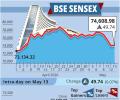
Indian benchmark equity indices, Sensex and Nifty, closed marginally higher, breaking a four-day losing streak, despite elevated crude oil prices and ongoing geopolitical uncertainties. The market saw a temporary pause in panic selling, though cautious sentiment persists.
Indian equity benchmark indices experienced a significant drop in early trade, with the BSE Sensex falling over 525 points and the NSE Nifty down more than 164 points, primarily due to rising crude oil prices and ongoing uncertainty surrounding the US-Iran conflict.
Indian stock markets concluded Tuesday's trading session lower, reversing intraday gains due to late-session selling in blue-chip stocks like HDFC Bank and Reliance Industries. The decline was primarily driven by the Indian rupee hitting a new record low against the US dollar and elevated global crude oil prices, compounded by geopolitical uncertainties.

Indian benchmark equity indices, Sensex and Nifty, closed lower due to investor caution over rising bond yields, a weaker rupee, and fresh fuel price hikes, which have revived inflation concerns.

The ICC Women's T20 World Cup 2026 is set to bring together the world's top teams for a month of fast-paced, high-stakes cricket, as they compete for the biggest prize in the shortest format of the game.

Adani Group Director Jeet Adani and Bharti Enterprises Vice Chairman Rakesh Bharti Mittal highlighted the importance of infrastructure, energy, and connectivity in shaping India's AI ecosystem, emphasising Visakhapatnam's potential as a major digital gateway.

Indian benchmark indices Sensex and Nifty closed higher, with the Sensex climbing 355.90 points, driven by positive state election results and better-than-expected Q4 earnings, despite ongoing geopolitical concerns.

Bollywood mothers multitask their children with their showbiz careers, and emerge even bigger stars! They celebrate Mother's Day with some adorable pictures.
Indian equities on Dalal Street saw volatility as global market trends and weak rupee impacted investor sentiment. Track Sensex, Nifty50 movement and key market drivers for May 5, 2026.

Indian benchmark indices Sensex and Nifty experienced a significant tumble in early trade, driven by surging global oil prices, continuous outflows by Foreign Institutional Investors (FIIs), and persistent geopolitical uncertainties, particularly in West Asia.

India Women's cricket team will face England in a three-match T20 series as a final preparation for the upcoming T20 World Cup.

Companies are already diversifying sourcing, raising prices, and reworking operating models as the disruption drags on.

Indian stock markets experienced a significant sell-off, with the Sensex tumbling over 1,300 points, driven by escalating crude oil prices due to US-Iran tensions and Prime Minister Narendra Modi's call for austerity measures, which amplified investor concerns about India's economic outlook.
Indian stock markets experienced a second consecutive day of losses, with the Sensex tumbling 852 points, as crude oil prices surpassed USD 100 per barrel due to stalled US-Iran negotiations and escalating geopolitical tensions in West Asia.

Among Sensex firms, Sun Pharma, Tata Steel, Power Grid, Asian Paints, NTPC and Bharti Airtel were the biggest laggards. Tata Consultancy Services, Tech Mahindra, Infosys, Adani Ports, Axis Bank and HCL Tech were among the gainers.

Indian equity benchmarks Sensex and Nifty surged nearly 1 per cent, driven by strong earnings reports from FMCG and auto sectors, alongside a rally in Asian markets and signs of de-escalation in geopolitical tensions.
Indian benchmark indices Sensex and Nifty closed lower in a volatile session due to profit-taking in banking and financial shares, despite earlier gains driven by easing geopolitical tensions. Analysts suggest investors remain cautious and are not aggressively chasing the recent rally.

Indian cricketer Jemimah Rodrigues discusses the team's motivation and preparation for the upcoming ICC Women's T20 World Cup, highlighting the importance of consistent training and the emergence of key players like Nandani. The team aims to build on their previous success and overcome challenges, including the absence of injured player Amanjot.
Indian stock markets tumbled sharply with the Sensex falling 800 points and nearly 4 lakh crore wiped out in a single session. Here are the 6 key factors, including rupee weakness and global cues, behind the crash.

Among Sensex firms, Axis Bank tanked the most by 5.03 per cent. Eternal, HCL Tech, Bajaj Finserv, Tata Steel, UltraTech Cement and Bajaj Finance were also among the laggards. However, Titan, Bharti Airtel, Mahindra & Mahindra and Asian Paints were among the gainers.

Indian benchmark indices Sensex and Nifty experienced declines due to a sharp rally in crude oil prices, continuous foreign fund outflows, and geopolitical uncertainties. Regulatory developments in the banking sector, particularly the implementation of the Expected Credit Loss (ECL) framework, also contributed to the selling pressure.
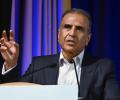
Bharti Global, the international investment arm of Bharti Enterprises, has decided to buy 24.5 per cent equity in BT Group - a move that will make the Indian conglomerate the biggest shareholder in the UK's second-largest telecom company both in terms of market value and subscriber count. The shares are being purchased from billionaire Patrick Drahi's Altice UK through a combination of cash and debt .

Indian markets on Dalal Street rallied sharply as easing tensions in the US-Iran conflict and stable oil prices boosted sentiment. Track Nifty 50 and BSE Sensex performance and key global triggers.

From the Sensex pack, Asian Paints, Tech Mahindra, Tata Consultancy Services, Bajaj Finserv, Adani Ports, HCL Technologies, Bharti Airtel, Infosys, Trent, Reliance Industries, UltraTech Cement, Sun Pharmaceuticals, Eternal, Titan and Bajaj Finance were the gainers. On the other hand, Tata Steel, Tata Motors Passenger Vehicles, Tata Motors Commercial Vehicles, Bharat Electronics, Kotak Mahindra Bank and PowerGrid were the laggards.

Among Sensex firms, Bharti Airtel, Reliance Industries, Eternal, State Bank of India, Tata Steel and HDFC Bank were the major gainers. However, Kotak Mahindra Bank, Bharat Electronics, Infosys and Bajaj Finance were among the laggards.

Indian benchmark stock indices Sensex and Nifty rallied for the second consecutive day, closing nearly 1 per cent higher, driven by gains in metal and auto sectors and positive global market trends.

India's market landscape is undergoing significant shifts, with bank-backed brokerages potentially regaining dominance over discount platforms due to regulatory changes and increased taxes, while the IPO pipeline faces a slowdown amid heightened global volatility.

Indian equity markets experienced a significant downturn as geopolitical tensions in West Asia, rising oil prices, and foreign fund outflows dampened investor confidence. The Sensex and Nifty both fell sharply in early trade, reflecting broader global market weakness.
Indian stock market indices Sensex and Nifty experienced a significant decline, driven by rising crude oil prices, sustained foreign fund outflows, and selling pressure in major bank stocks.
Indian benchmark stock indices, Sensex and Nifty, surged over 1 per cent, driven by optimism surrounding potential US-Iran peace talks and a significant drop in crude oil prices below the USD 100 per barrel mark. This de-escalation in geopolitical concerns and easing inflation pressures provided a substantial boost to investor sentiment.
Indian stock market benchmarks Sensex and Nifty rebounded strongly after a two-day decline, driven by falling crude oil prices and positive global cues amid hopes of de-escalation in the Middle East.
